

Marketing automation has spent the last two decades getting very good at execution. We define the audience, build the workflow, set the rules, launch the campaign, and measure what happened. It worked because the system did exactly what we told it to do.
AI is changing that relationship.
We are moving into a model where marketing technology is not simply executing predefined instructions. It is increasingly interpreting signals, identifying patterns, predicting likely outcomes, adjusting experiences, and helping determine what should happen next.
That is a much bigger change than adding AI-generated copy to a campaign. It changes how we think about customer journeys, personalization, data, decisioning, and even the role of the marketer.
Here are the five shifts I think matter most.
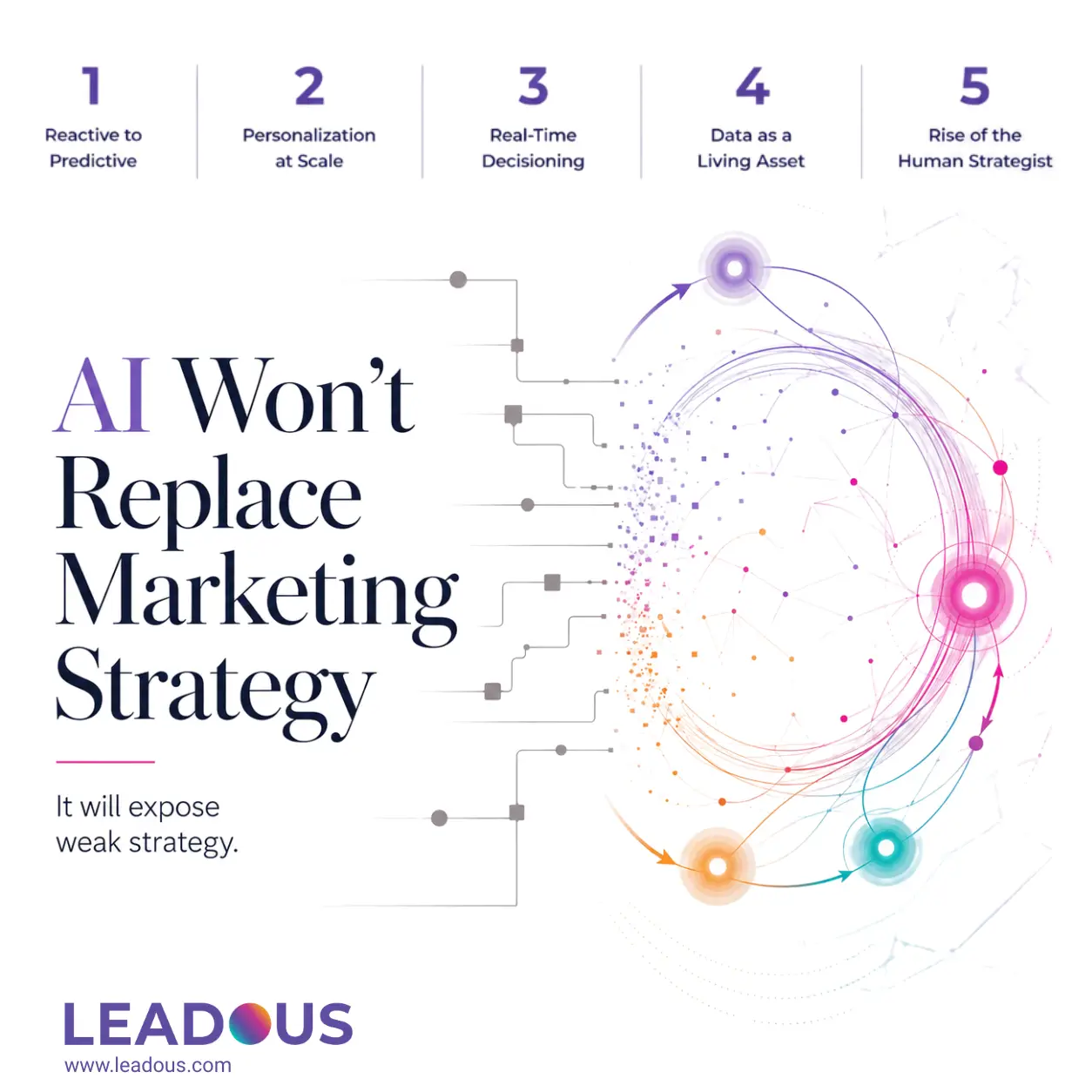
1. From Reactive to Predictive
Until recently, marketing automation was primarily reactive.
Someone filled out a form, entered a segment, clicked an email, visited a pricing page, abandoned a cart, or reached a lead score threshold. The platform recognized that action and triggered whatever workflow we had already designed.
If this happens, do that.
That model is not disappearing, but AI is adding another layer: prediction.
Instead of only responding to what a customer has already done, marketing systems can increasingly evaluate behavioral, transactional, engagement, profile, and contextual signals to determine what that person is likely to do next.
That changes the conversation. Rather than asking, “What action did this customer take?” we can start asking, “What is this customer showing us about their intent?”
That might mean recognizing increased purchase propensity before someone explicitly raises their hand. It could mean identifying declining engagement before the customer disappears. Or it could mean recognizing that a particular message, offer, or product is becoming more relevant based on a series of small behavioral signals that would be nearly impossible for a marketer to evaluate manually.
The customer journey becomes less rigid as a result. Instead of forcing every person through a predetermined sequence, journeys can adapt as new information becomes available. Audience membership can change. Offers can change. Messaging can change. Timing can change. In some cases, the smartest decision may be not to send anything at all.
This is where platforms such as Adobe Journey Optimizer become more interesting. The value is not simply the ability to automate another step. It is the ability to use real-time signals and decisioning to make the journey itself more responsive. The same shift is also changing how companies think about AI workflow activation: not as a collection of isolated AI features, but as intelligence embedded into the operating model.
More intelligent automation is not about increasing the number of automated touches. It is about increasing the quality of the decisions behind them.
The future of automation is not simply determining what happens next. It is determining what should happen next.
2. Personalization That Scales (Finally)
For years, we have called a lot of things personalization that really were not very personal.
First name. Company name. Industry. Product purchased. Maybe a different email based on a segment.
Useful? Yes. Personalized? Technically. But not necessarily meaningful.
Real personalization is about context.
What does this customer need right now? What have they already seen? What have they ignored? What have they purchased? What is changing in their behavior? What channel are they using? What is relevant to them at this exact point in the relationship?
That is where AI starts to make personalization much more interesting.
Instead of using a handful of profile fields to determine which version of a campaign someone receives, AI can help evaluate a much broader collection of customer signals and use that information to shape the experience itself.
The message can change. The offer can change. The content can change. The journey path can change. The timing can change.
And it can happen across far larger audiences than a marketing team could realistically manage by hand.
That is the part we have been missing.
Historically, there has been a direct relationship between personalization and operational complexity. The more segments you created, the more campaigns you had to build. The more campaigns you built, the more content you needed. More content meant more approvals, more QA, more reporting, and more things that could break.
Eventually, “personalization at scale” often became code for “we have created an operational nightmare.”
AI has the potential to change that equation. If technology can help generate variations, evaluate customer context, select the appropriate experience, and learn from the results, the operational burden does not have to grow at the same rate as the personalization.
But there is an important dependency: the platform needs usable data. A connected profile through Adobe Experience Platform or a real-time customer data platform can give decisioning systems the context they need. Without that foundation, “personalization” can become little more than faster guessing.
That does not mean handing every decision to the machine. It means giving the machine more intelligence while giving the marketer better control over the strategy.
3. Decisioning at the Edge
Marketing has always had a latency problem.
Something happens. The data gets collected. A report gets generated. Someone analyzes it. A meeting happens. The team decides what to change. The campaign gets adjusted.
By then, the customer may already be somewhere else.
AI-driven marketing automation is compressing that cycle.
More decisions can now happen while the interaction is occurring rather than after the campaign is over. A customer arrives on a website. Their profile, behavior, eligibility, previous interactions, and current context can influence which experience appears. A customer enters a journey and new behavior changes which path they follow. A particular offer performs better for a specific audience and the system can begin using that information to inform future decisions.
That is a very different model from waiting until the end of the month to discover that something did not work.
The practical shift is from periodic optimization to continuous decisioning. This is where journey orchestration and experimentation and optimization start to converge. The organization is not simply measuring performance after the fact; it is creating a system that can learn and adjust inside defined business rules.
But there is an important distinction here.
Faster decisioning does not mean marketers should give up control. Quite the opposite. As machines make more decisions, marketers have to become much clearer about the boundaries around those decisions.
What is the business objective? Who is eligible? Who is excluded? What are the frequency rules? Which actions are acceptable? When does a human need to intervene? What does success actually mean?
AI can make decisions quickly. That does not automatically mean it is making the right decisions.
Speed makes governance more important, not less.
4. Data as a Living Asset
Most companies do not have a data shortage.
They have plenty of data. It is sitting in CRM platforms, marketing automation systems, websites, analytics tools, service platforms, data warehouses, commerce systems, event platforms, sales tools, and a growing collection of applications that all know something slightly different about the customer.
The problem is making that data useful.
AI becomes considerably more valuable when customer data is connected, trusted, current, and accessible at the moment a decision needs to be made.
At the same time, AI is beginning to change the way we manage that information. Systems can help identify duplicates, surface anomalies, classify records, recognize patterns, enrich profiles, detect changing behaviors, and identify relationships in the data that a human team would struggle to see manually.
That turns customer data into something much more dynamic.
Instead of thinking of a customer profile as a static record, think of it as a constantly changing collection of signals.
A website visit changes what we know. A product purchase changes what we know. An email interaction changes what we know. A service ticket changes what we know. A lack of activity can change what we know too.
Every one of those signals has the potential to influence what happens next.
That is why integration and system connectivity are not secondary technical concerns in an AI strategy. They are part of the strategy. If customer data is late, duplicated, incomplete, or trapped in disconnected systems, the decisioning layer is working with a distorted picture.
It also changes measurement. Tools such as Customer Journey Analytics matter because organizations need to understand not just whether a campaign performed, but how interactions across the journey influenced behavior and outcomes.
AI does not eliminate bad data architecture.
If identity is unreliable, consent is unclear, integrations are broken, lifecycle definitions conflict, or your CRM cannot be trusted, adding AI does not magically repair the foundation. It simply gives you a faster way to act on bad information.
The companies that get the most value from AI will not necessarily be the companies with the most AI tools. They will be the companies that treat data, governance, orchestration, decisioning, and measurement as one connected system.
5. The Rise of the Human Strategist
This may be the most important shift of all.
As AI absorbs more of the execution layer, the value of human judgment increases.
A lot of marketing work has traditionally been translating strategy into technology. Build the campaign. Create the audience. Write the variations. Configure the workflow. Set the rules. Run the test. Pull the report. Make the adjustment.
AI can already assist with many of those tasks, and it will get increasingly good at them.
That does not make marketers less important. It changes which marketers become more valuable.
When a system can generate twenty subject lines in seconds, writing twenty subject lines is no longer the scarce skill. Knowing what the customer needs to hear is.
When a platform can recommend an audience, building the audience is no longer the entire job. Knowing whether that is the right audience becomes more important.
When AI can optimize a journey automatically, the marketer has to understand what outcome the journey should actually be optimizing for.
This is where strategy becomes the differentiator.
What are we trying to accomplish? What customer behavior matters? Which signals are meaningful? What should the technology be allowed to decide? Where should humans stay involved? What experience are we trying to create? How do we know whether the system is improving that experience or simply increasing activity?
Those questions require business context, customer understanding, judgment, creativity, governance, and sometimes a healthy amount of skepticism.
They also require a different operating model. Adoption, enablement, and governance become more important when the technology can do more, not less. For larger organizations, a clearly defined Center of Excellence can help establish decision rights, standards, measurement, and accountability across teams.
AI does not remove the need for those things.
It makes them more valuable.
AI Won’t Replace Marketing Strategy. It Will Expose Weak Strategy.
There is a larger point behind all five of these shifts.
AI makes execution easier.
That sounds entirely positive until you consider what happens when the underlying strategy is wrong.
If the audience is wrong, AI can reach the wrong people more efficiently. If the data is unreliable, AI can make the wrong decision faster. If the value proposition is weak, AI can create fifty versions of a weak message. If the customer experience is poorly designed, AI can scale the problem. If there is no governance, automation can produce inconsistency faster than a human team ever could.
AI is an amplifier.
It can amplify good systems. It can also amplify weak ones.
That is why I do not believe the future of marketing belongs to the teams that simply adopt AI the fastest. It belongs to the teams that understand where it belongs.
The strongest organizations will connect technology with clean data, thoughtful customer journeys, clear business rules, disciplined measurement, strong governance, and people who understand how all of those pieces work together.
For some companies, that means revisiting platform strategy and readiness before adding another AI tool. For others, it means getting more value from technology they already own, whether that is Marketo Engage, HubSpot, Adobe Journey Optimizer, or a broader customer experience stack.
That is the real shift happening in marketing automation.
We started by asking, “What can we automate?”
Now the more important question is:
What should happen next?
Increasingly, the answer will come from a combination of human strategy and machine intelligence.
That is where this gets interesting.
Frequently Asked Questions
What is AI marketing automation?
AI marketing automation combines traditional automated workflows with artificial intelligence and machine learning capabilities that can analyze customer signals, predict outcomes, personalize experiences, generate content, optimize decisions, and recommend or select next actions. Traditional automation typically follows predefined rules; AI-driven automation can add prediction and optimization to those workflows.
How is AI changing marketing automation in 2026?
The biggest shift is from predetermined campaign execution toward more adaptive customer journey orchestration. AI can influence audience selection, content, timing, offers, journey paths, predictions, experimentation, and next-best-action decisions.
Will AI replace marketing operations teams?
No. It will automate portions of execution, configuration, content production, analysis, and optimization. The role of marketing operations is likely to move further toward architecture, governance, measurement, experimentation, data strategy, platform strategy, and AI oversight.
What is predictive marketing automation?
Predictive marketing automation uses statistical models, machine learning, or AI to estimate likely customer behaviors or outcomes and then uses those predictions to influence marketing activity. Examples include purchase propensity, churn likelihood, product interest, engagement probability, offer selection, account prioritization, and send-time optimization.
What should companies do before implementing AI marketing automation?
Start with the foundation. Evaluate customer data quality, identity resolution, consent and governance, platform integrations, lifecycle definitions, journey architecture, measurement, AI decision rights, and operating processes. AI performs best when the underlying marketing system is already coherent.
Where Leadous Fits
The technology is moving quickly. The harder work is determining where AI belongs inside your marketing operating model and how your data, platforms, business rules, measurement, and people need to work together.
That is the work we do at Leadous. Not adding AI for the sake of adding AI, but helping teams decide where intelligence can improve the decisions their marketing organization already needs to make.
Where to Go Next
Want to keep going on the people side of this shift? Read How AI Is Reshaping the Role of the Digital Marketing Team.
Ready to move from AI ideas into operating reality? See how we approach AI Workflow Activation.